
Navigating the forest of red tape
Disclaimer
We are not claiming to be small business experts. As such, no information presented here should be considered professional advice. Do not pursue any action solely on our advice before consulting an actual expert (lawyer, accountant, customs official, etc.). We just want to share our experience of blindly fumbling through the various red tape that comes with owning a small media business. Maybe this info will give you the tools to know where to look if you decide to start your own sound effects, photography, drone piloting, or other small media business.
Neither Blackguard Sound, nor either partner (Jason or Drew), will accept any responsibility for information presented here that results in damages to the reader. That said, we have been an honest-to-goodness business since 2018. This business has brought us around the world and has resulted in halfway decent gross sales, so we’ve picked up a few things along the way.
Business Structure
This is the area we’re least qualified to speak on, but I do want to mention a few basic things. Blackguard SMG is a Partnership. Most small media businesses will do better as an LLC, but we have a weird situation where there are only two partners in the company, and we have known each other for 25+ years. That familiarity allows us to honestly assess whether we are on the same page, financially speaking. For us, this project has never been about making money - it’s been about the journey, the travel, the experiences, and the gear. In most other situations, making money will be THE goal and an LLC will do a better job of protecting all involved. But, when we decided to start this thing, it was easier to create a Partnership (less paperwork and no legal fees). We went into it with open eyes, so it’s never been an issue for us.
We are a registered Partnership with the State of Florida Division of Corporations. We registered our Fictitious Name through the Sunbiz.org website. Florida arguably has a ton of governance issues, but starting a small business is not one of them. They make it easy and affordable. Once we were registered with Florida, we applied for an EIN (Employer Identification Number) with the IRS. The EIN is our federal tax ID. Think of the EIN as a social security number for your business. This will be relevant when we get to the taxes section.
Equipment Insurance
Owning a media business usually means owning a ton of expensive, specialty equipment. For us, that’s microphones, recorders, synthesizers, speakers, interfaces, etc. But also, the cameras, lenses, drones, and computers that we use to make promotional material. Once you start buying gear, it quickly becomes apparent that equipment insurance is necessary to protect your business from serious loss.
How to Start
We get our equipment insurance through Film Emporium. They are an insurer that specializes in working with film production companies, so they don’t bat an eye at the sorts of equipment lists we submit. When we started with Film Emporium, we had to submit an itemized equipment list. That list includes the following information: make, model, description, replacement value, and serial number (serial numbers are only required for individual items with a replacement value over $10K). Every year, when it’s time to renew the insurance, we add all the past year’s equipment purchases to the list. Then, they reassess the annual rate we pay based on the total replacement value.
Coverage
Without revealing specific numbers, the rate we pay for this annual equipment insurance is roughly one percent of the total replacement value. Other things to consider that may affect your rate include whether you need the coverage to be international and whether you intend to rent equipment (either incoming or outgoing). Each of those items is a checkbox on the application paperwork and you will pay more for each of these options. We extend our coverage internationally and we sometimes rent equipment from other companies, so those two boxes are checked. We never rent our gear out to others, so we don’t need to pay for that coverage.
We’ve had some minor losses over the years, but fortunately we’ve never had to file a claim. But we’re happy to pay for the peace of mind!
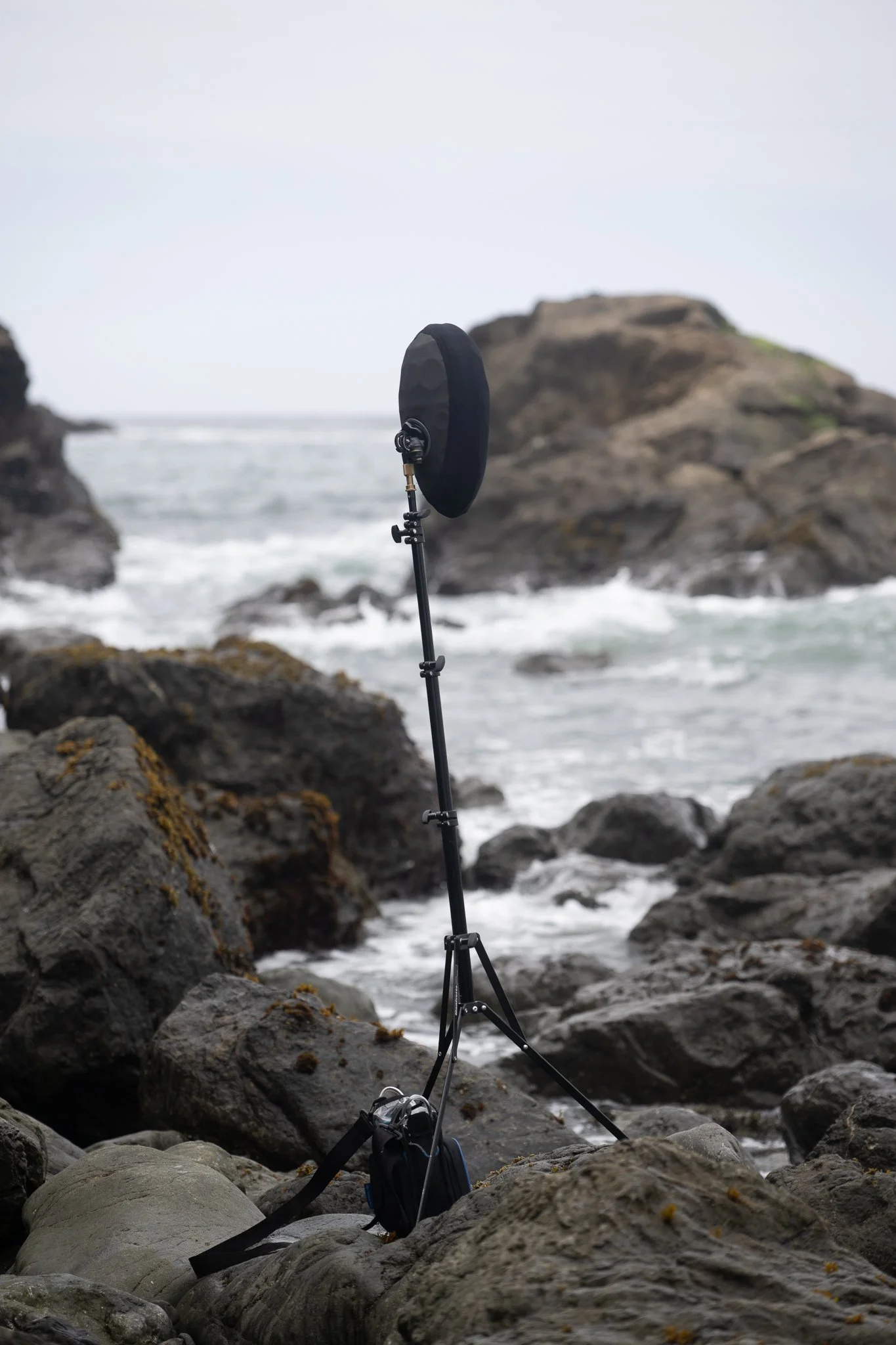
Equipment in harm’s way. Good thing we’re insured!
Production Insurance
Production Insurance can open doors, quite literally. For example, a restaurant owner may be rightfully hesitant to allow sound recordists into their kitchen because they’re worried about the liability. What if we were to get injured by something on their property, like a hot burner? Or even worse, what if the work we’re doing causes injury to one of their employees or damages their equipment? But if you can give that same restaurant owner a certificate of insurance (COI) that lists them as an additionally insured entity they will be much more likely to allow you to record. Also, most permitting bodies (cities and other organizations) require a minimum $1 million liability policy for any sort of permit to be issued. More on permits below.
Coverage
The amount of coverage you need will depend on the size of your crew. For us, there are never more than four people involved and we make a very small footprint so we just go with the $1 million policy that will qualify us to get most permits. For a film production with a full complement of crew more coverage will be required. Our annual cost for that coverage is about $500. We don’t always use our liability insurance in a given year, but if you allow a policy to lapse it will be much harder to get a new policy when you need one. So, we just consider it the cost of doing business and pay it every year no matter what.
We get our production insurance through Liberty Mutual. It’s a big company so they have a very easy online, automated process for issuing COIs and you can get one issued instantly. With a previous company, we had to send an email to request a COI, it had to be processed and approved and then we’d get it a couple of business days later. Fortunately, they dropped us because they stopped covering the entertainment sector and we were able to get something that works a little easier.
Permits
Even though we’re just sound recordists, and not a full production crew, we will try to get film permits when we can. Especially if we’re going to be in high-traffic areas making any kind of footprint that may be disruptive or attract police attention. Generally, the police tend to get suspicious if anyone is setting up stands, running wires, etc. When police see an official permit, they can become an asset. We’ve had bored cops stick around as crowd control in downtown areas just because what we’re doing was interesting…and legal. Other times, when we’re in low traffic areas or not taking up any substantial footprint, we will gamble and record guerilla-style. It’s a balance we’ve figured out after years of experience that tends to work for us.
How to Get a Permit
All that said - if you’re on public property, a permit is generally required. Hopefully, the location has a permitting body. We typically start by calling the local film commission (if there is one). This can be highly informative. For example, one job had us recording all over metro Miami. We gave the local film commission a list of locations and they helped us figure out all the different permitting authorities. It was a surprising number of different jurisdictions. The city of Miami is a separate entity from Miami-Dade County. Within greater Miami, different towns or neighborhoods, like Miami Beach or Coral Gables have their own permitting entities. Then, if you’re near railway tracks or bus stops, the permit comes from the department of transportation and not the local municipality. There’s no way we could have figured out that tangled web of permitting bodies without help from the film commission. They provided that service for free so it worked out great! Sometimes reaching out can lead to other pleasant surprises. Maybe they want to send someone from the office to do an interview. Or in the case of the Icelandic film commission, we got good intel on the things to avoid that would get us in trouble, while basically giving free reign to do anything else we wanted.
Each permitting body will require a COI naming them as additionally insured. They will also require a fee for issuing the permit. The cost of each permit varies widely. Some are free. Others range from $50-$100. Some are outrageous. In one city, the transit authority wanted to charge us $500/ hour to record on a subway platform. I explained to them that the one ambience of a subway platform would not generate anywhere near $500 in its entire lifespan, but they were firm. They were used to dealing with film crews and didn’t have any room to budge for other circumstances. That exorbitant charge led us to scale down the size of the rig and take our chances with a guerilla recording.

You made us do this…
Another consideration when applying for permits is impact. Some productions may be considered high impact. This could be because they have a large crew, or maybe because they need to shut down a city street, which would require a police presence. Or, in the case of something like national parks or nature preserves, anything with wheels and heavy light stands may be considered high impact because they could damage the terrain or interfere with wildlife. Fortunately, even our most involved setups would not be considered high impact, but it’s something to be aware of. In fact, we are so low impact that most permitting bodies are confused as to why we even contacted them or what our job even is…but it’s always best practice to get a permit if you need to. I’ve seen an entire wedding party in gowns and tuxes get kicked out of a city park because their ‘pro’ wedding photographer failed to secure a permit. I don’t imagine they got good reviews after that incident!
Sample Low Impact Film Permit - Miami Beach
None of the above addresses working on private property, which obviously requires permission and potentially payment on a case-by-case basis. Be prepared with proof of insurance and a good pitch to grease the wheels.
US National Parks Update
As of 2025, the National Park Service has new rules for film, photography, and audio recording that aim to make it easier for content creators to access the parks.
International Travel
Travel is easily our favorite part of having a sound effects recording company! There are some things to consider before attempting to work in another country. First, and this should go without saying – do lots of research into the location. Language, customs, hazards, diseases, wildlife…all that. Definitely get your passport well in advance. Sometimes there might be a backlog that adds weeks or months to the wait time. But you can find info about these topics all over the internet. We want to talk about the carnet.
What is a carnet?
Think of a carnet as a passport for your equipment. Why does your equipment need a passport? Well, there’s rightfully a lot of concern in the US and abroad about tariffs. A common way to attempt bypassing tariffs might be to go to an item’s country of origin, buy it there, and then pretend you brought it from home when re-entering the US. Try this at your own peril. The carnet is an internationally recognized way to prove that you left a country with the same equipment you brought in. It allows you to temporarily import goods without paying duties and taxes, so the benefits cut both ways. It also provides a small layer of protection against unscrupulous border agents who may accuse you of attempting some scam and solicit a bribe to keep quiet. It’s best to have well known and widely recognized paperwork when crossing international boundaries. Remember – cases full of esoteric, but obviously expensive electronic equipment will ALWAYS draw attention at the border.
How To Secure a Carnet
During the carnet application process, you will be required to file a travel itinerary (it is possible to chain together multiple countries), an equipment list, valid passport, proof of equipment insurance, and a small, refundable security bond payment (in case you don’t follow the rules). The equipment list needs to be quite detailed including make, model, serial number, and value. We have found that it’s OK to clump together smaller, non-serial items into groups. Like ‘assorted cables’ or ‘assorted batteries’ and try your best to assign a rough value to the lot. But anything that has a serial number on it must be listed separately. And customs people are pretty savvy. They know the camera body and the lens have different serial numbers, for example.
Using a Carnet
Then, the list must be validated by a customs agent in the US before you leave. I’d recommend bringing it to the customs office a day in advance because it might take a long time to dig through your cases and find every serial number. Sometimes the agent is very strict and may demand to see every item. On other occasions, they’ve simply chosen the top five most expensive things and assumed everything else was OK. But you have to plan for it to take a while, and you don’t want to be doing that when you’re trying to catch a flight!
Next, when you arrive at your destination there’s usually a separate line for people travelling with carnets that need to be inspected. Just like in the US, the difficulty depends on the agent and local rules. In Iceland, the customs agent gave the paperwork a cursory glance and stamped it without looking at any equipment. In Indonesia we were at the airport for hours as they meticulously tore apart a carnet with hundreds of items on it. In any case, once you have the paperwork stamped you and your equipment are now in the country legally. Once your paperwork is validated it is vital that you keep it intact. Treat the carnet folder just as you would your passport because leaving the country without it is going to be an expensive ordeal!
When it’s time to return home you simply repeat the process in reverse. Except this time, it’s already been validated by customs agents in two different countries, so you probably don’t need to go to a customs office the day before – just arrive at the airport super early. One final check when you return to the states and you’re done. Note that the carnet is good for up to one year. So, if you are travelling to the same country several times in a year with the same equipment you don’t need to apply for a new carnet every time. Once that year is up you have to mail the carnet back to the company that produced it. I like to set a calendar reminder because there’s no way I’m going to remember that tiny detail a year on. After they have received it, you will get your security bond returned (assuming you didn’t break any laws). For this reason, many people may elect to return the carnet immediately upon return to the US so they can get the bond refunded. Especially of they don’t anticipate needing it again in the remainder of the year.
Where to Get a Carnet
The company we use to secure carnets is Boomerang Carnets. They have been affordable compared to other options and are very easy to work with.

Have mic, will travel.
Taxes
Our Partnership files federal tax forms. Partnerships are considered ‘pass through entities’. This means that all profits and losses are passed through to the individual partners (as defined by the partner’s share of the business – in our case 50/50). Those profits and losses are reported via a couple of forms that we’ll lay out below. Each partner then files an individual federal income tax return reporting their share of the profits and losses. Fortunately, Florida does not have a state income tax, but we do pay federal income tax on the business’ profits.
Business Filing Date
One very important note – business taxes have an earlier filing date than personal taxes! This caught us off guard in the first year and we got fined several hundred dollars by the IRS and had to do a ton of extra paperwork! Don’t fall into this trap. As of this writing in 2025, the filing date for a Partnership is March 17th – almost a full month ahead of the personal filing date. In hindsight, this makes perfect sense since the individual partners can’t do their taxes until the business has submitted. Doh!
Forms
The first tax form we fill out is a Form 1065 ‘U.S. Return of Partnership Income’. That’s where we report the business’ profits and losses for the year. We have to carefully document all income and expenses and those must match up with an ongoing account ledger. That is, on January 1st our account has X amount in it. Then once all income and expenses have been entered our account should have Y amount in it on December 31st. That number becomes the starting number for the next year, and so on. If the business has a bank account and all income and expenses flow through that, the work basically does itself. If income is flowing to and from other entities (like PayPal, for example) we have to be much more careful when doing the math. This form is where we enter the EIN mentioned earlier.
The next tax form we do is a Schedule K-1. The K-1 is used to report each partner’s share of the profits and losses. The math is really easy here since there are only two of us and the split is 50/50. We each use this document to report the income of the business on our personal taxes, similar to how a freelancer would report freelance income. If the business makes a profit, we have to pay the taxes on it. If the business loses money in a given year, we can report the loss as a write-off. Now, we’ve done our duty as citizens and probably paid more in taxes than most politicians or billionaires.
Conclusion
Wow, that was a lot of writing and none of it was about audio! These are the things we were never taught in school. Even though we both have multiple media degrees, no one ever taught us how to be freelancers or entrepreneurs. This all had to be figured out on the fly. Personally, I find the whole thing fascinating. I don’t feel bad when we have to pay the bills and do the paperwork. We can be proud of doing things the right way, and it can be a bridge to talk to other small business owners who don’t work in entertainment. It can also be good for business. Our biggest, best-paying clients have always required the business infrastructure to be in place in order to engage with them. So, we highly recommend being a real business!